Wednesday, March 26, 2014

Compelling Faces in Art - Jozef Israëls, Portrait of an Old Man.


Jozef Israëls, the Dutch painter (and most respected Dutch artist of the second half of the nineteenth century), was known as the Great “Rabbi” of painting. He was a descendent of Rembrandt and teacher of Van Gogh. His art was traditional, while at the same time pushing the limits. You could say, that although he had a light foot in modernity, he had a heavier foot in tradition. As the son of lower-class Jewish parents, Israëls was able to express with peculiar intensity, the life of the poor and humble. 

In Portrait of an Old Man, we see how he was committed to the simple in art and life. The words of William Blake (from The Auguries of Innocence) would become his guiding principle: “to see the world in a grain of sand, and a heaven in a wildflower.” 

---Translating softly, compassionately, and with understanding, interest in the smallest actions of human beings.

The subject here is cloaked in broad strokes of light and shade, presenting the old man without any neglect of detail . He is a man of honor and comfort. He balances his curiosities with his sensibilities; an acquired wisdom that only comes with age. He has not lived in vain. He knows the value of the things for which we suffer. 

As Anaïs Nin said, “The possession of knowledge does not kill the sense of wonder and mystery. There is always more mystery.”

Saturday, March 22, 2014

Compelling Faces in Art - Simon Massey di Vallazza.


Chaos theory tells us that seemingly random events are actually predictable from simple deterministic equations. But, in the scientific context, the word chaos has a slightly different meaning than it does in its general usage as “a state of confusion, lacking any order.” 

Our world is full of chaotic compositions. A few will recognize this and become artists. Their task then is to confront the chaos and bring it back into order. 

Henry Adams said in The Education of Henry Adams, “Chaos was the law of nature; Order was the dream of man.” And Carl Jung inferred that in this cosmos of disorder, there is a secret order. 

In this painting by Simon Massey di Vallazza, I see beauty in the confusion, and truth as collision become form; the artist searching disorder for its unifying principle. A form emerges as a face when the whole and the parts are seen at once, mutually producing and explaining each other. It is here, where we find an open channel to the soul.

Chuck Palahniuk wrote in Survivor: “There are only patterns, patterns on top of patterns, patterns that affect other patterns. Patterns hidden by patterns. Patterns within patterns. 
If you watch close, history does nothing but repeat itself. 
What we call chaos is just patterns we haven't recognized. What we call random is just patterns we can't decipher. what we can't understand we call nonsense. What we can't read we call gibberish.
There is no free will. 
There are no variables.”

Compelling Faces in Art - Balthus, Rosabianca Skira-Venturi.


Try to find any information about Rosabianca Skira-Venturi, and you will have great difficulty. Except, that she was the author of a series of books, most notably, A Weekend With Leonardo Da Vinci. But Balthus left us with this portrait (1949) of her. An exceptional beauty, in a reserved pose, presented with the notion of less is more. As Robert Brault said, “You don't torture a painting that has already confessed.” Simplicity, here, is balanced with sophistication. 

As less information often leads to more interpretation, I still want to know: Who is this woman?

Compelling Faces in Art - Paul Delvaux - Pygmalion (partial).


Pygmalion was a Cypriot sculptor who abhorred all women for their lasciviousness, but fell in love with an ivory female statue that he carved. He pleaded to Aphrodite to animate his Galatea, and was not refused his happiness.

Here, Delvaux revisits the legend and broadens the context in which one can think of Pygmalion’s story. It is the woman who creates the statue of a man and falls for it. The context can be broadened further: disregarding any restrictions or conventions implied by gender. 

The reinterpretation of any myth is based on mutability of the past, through a continuous equilibrium between history and contemporaneity. 
So how does this translate to me (or you)?

Voltaire said, “Judge a man by his questions rather than by his answers.” And isn’t it fun to look at a subject from various points of view, anyway?

I like what K.J. Bishop said in The Etched City: “I am always a different man; a reinterpretation of the man I was yesterday, and the day before, and all the days I have lived. The past is gone, was always gone; it does not exist, except in memory, and what is memory but thought, a copy of perception, no less but no more replete with truth than any passing whim, fancy, or other agitation of the mind. And if it is actions, words, thoughts that define an individual, those definitions alter like the weather - if continuity and pattern are often discernible, so are chaos and sudden change.”

Friday, March 21, 2014

Compelling Faces in Art - Paul Klee , Young proletarian, 1919.


During the Roman Empire the contribution of a proletarius to the Roman society was seen in his ability to produce children that would colonize new territories. In Marxist theory, the term proletariat signifies the social class that does not have ownership of the means of production and whose only means of subsistence is to sell their labor power for a wage or salary. 

Today, there is perhaps some confusion. Part of the confusion is that capital has sought (successfully) to blur the distinction between capitalist and worker, for example by encouraging workers to become shareholders, and encouraging a confused view of class based on a variety of issues, including the self-image of the “middle class” as perceived capitalists. 

One thing is for sure. Most of the recent economic growth is going to an extraordinarily small share of the population: 95% of the gains from the recovery have gone to the richest 1% of people, whose share of overall income is once again close to its highest level in a century. 

The recent concentration of income gains among the most affluent is both politically dangerous and economically damaging. 

The reason I find this Klee painting so compelling is how it depicts this modern dilemma. The economy is an illusion. We are still nothing more than the procreators of more labor. Certainly a great deal of intelligence must be invested in ignorance when the need for illusion is deep. 

In this face, I can see how the words of Joseph P. Blodgett ring true: “It's all illusion: the illusion of space, the illusion of mass, the illusion of light. The illusions go on and on, there is no limit to the number of illusions you can come up with.”

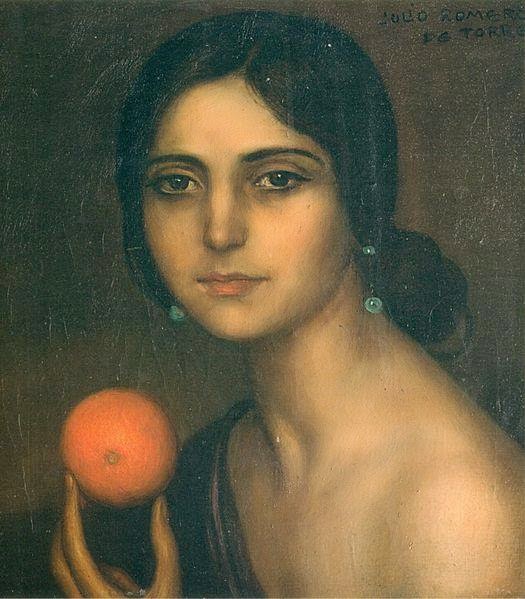
Compelling Faces in Art - Julio Romero de Torres, Gitana de la naranja.


Symbolism (a late nineteenth-century art movement), basically was a reaction against Realism (which elevated the humble and the ordinary over the ideal, and represented reality in all its grittiness). Symbolism was concerned with the imagination and dreams; the realm of absolute truths that could only be described indirectly.

“...they are perceptible surfaces created to represent their esoteric affinities with the primordial Ideals. In a nutshell, 'to depict not the thing but the effect it produces.’” - from Jean Moréas’ Symbolist Manifesto ("Le Symbolisme") in Le Figaro on 18 September 1886.

Gitana de la naranja by Julio Romero de Torres is undated. But we know he also painted Oranges and Lemons in 1927, and The Girl in the Orange in 1928. Both are similar to the one we are looking at here. 

A woman is the protagonist. She is sensual, with an almost tragic and ambiguous expression. She holds an orange, something that finds its way in to many of Torres’s paintings. What could it mean? Is it a symbol of fertility? We do know that Eastern cultures believe that Orange trees are a symbol of love. And, also that Orange represents gluttony in Christianity. 

The thing I find more interesting is the mixture of the idealistic with elements of a realistic portrait. This painting resembles more of a realistic portrait, yet the idealistic air places his figure in a vague halo of timelessness, giving this Andalusian the physical characteristics of a universal archetype, of feminine beauty.

Thursday, March 20, 2014

Compelling Faces in Art - Franz Xaver Messerschmidt, Character Heads.


Franz Xaver Messerschmidt (German-Austrian, 1736-1783) was one of the most fascinating sculptors of the Enlightenment. His most famous group of works, the studies of heads, are known today as the Character Heads (altogether 69 heads). 

In this sculpture, we have a face contorted into an extreme grimace. It is highly expressive, manifesting emotions that defy interpretation. In this respect, it is very modern. What exactly are we looking at? This sort of confusion pervades today’s art world. Often the sales pitch comes in the form of quasi-religious rhetoric, although the sacred and the profane have rarely been separated in art. 

Now there seems to be as many aesthetics and realities as there are artists, while the artistic elite, ambiguously credited and with access to the media, has established a new criterion for aesthetic appraisal. 

Ernst Gombrich wrote of da Vinci’s Ugly Faces, “...such monstrosities and malformations - the dwarf, the cripple and the bizarre physiognomy - belonged to the category of 'curiosities' to be gaped at ..." 

In comparison, Messerschmidt’s Heads might seem merely irreverent. Perhaps, even satire. The difference is that they are not remote, but too close. They mirror modern art in acknowledging the base and the irrational.

I think Maurice Tuchman addressed this when he wrote, “The universe is a single, living substance; mind and matter also are one; all things evolve in dialectical opposition; thus the universe comprises paired opposites (male-female, light-dark, vertical-horizontal, positive-negative); everything corresponds in a universal analogy, with things above as they are below.”

The beautiful and the ugly.
The sacred and the profane.