The presentation was a
weighty exploration, which
no doubt consisted of a
beginning, middle, and
one very sad, sad end,
imputations compacted
temporally in the
thesis, an arc of
sensation, which led
from case to captive,
charged with desire,
prospect, and ruin,
revealing the most
sympathetic story ever told.
Friday, March 4, 2011


Monday, November 22, 2010
15 Books in 15 Minutes
This is my list of "books you can come up with in fifteen minutes" that had an impact on you. Several friends have passed along their list, so here is my contribution.
1. Gospel, by Wilton Barnhardt
2. Lonesome Dove, by Larry McMurtry
3. Son of the Morning Star, by Evan S. Connel
4. The Marx Family Saga, by Juan Goytisolo
5. The Adventures of Huckleberry Finn, by Mark Twain
6. The Savage Detectives, by Robeto Bolaño
7. The Name of the Rose, by Umberto Eco
8. The Big Rock Candy Mountain, by Wallace Stegner
9. Death and the Penguin, by Andrey Kurkov
10. The Twelve Chairs, by Ilf & Petrov
11. Tourist Season, by Carl Hiaason
12. Planet of the Apes, by Pierre Boulle
13. The Hobbit, by J.R.R. Tolkein
14. The Electric Kool-Aid Acid Test, by Tom Wolfe
15. A Confederate General From Big Sur, by Richard Brautigan
1. Gospel, by Wilton Barnhardt
2. Lonesome Dove, by Larry McMurtry
3. Son of the Morning Star, by Evan S. Connel
4. The Marx Family Saga, by Juan Goytisolo
5. The Adventures of Huckleberry Finn, by Mark Twain
6. The Savage Detectives, by Robeto Bolaño
7. The Name of the Rose, by Umberto Eco
8. The Big Rock Candy Mountain, by Wallace Stegner
9. Death and the Penguin, by Andrey Kurkov
10. The Twelve Chairs, by Ilf & Petrov
11. Tourist Season, by Carl Hiaason
12. Planet of the Apes, by Pierre Boulle
13. The Hobbit, by J.R.R. Tolkein
14. The Electric Kool-Aid Acid Test, by Tom Wolfe
15. A Confederate General From Big Sur, by Richard Brautigan
Tuesday, November 16, 2010
I am the Itinerate Poet
I am the Itinerate Poet.
Or at least, that’s what Seamus Heaney called me when we met.
I crashed the reception after the reading, entering through the kitchen. Why not? I said to myself. After all it was a three hour drive to get there.
He was right, you know.
I have always written poetry. And I have always worked jobs that kept me on the move and just below the poverty line. A dependent, you could say—friends and family always helping out with the bills and what not.
But always there was the poetry.
I don’t have any academic connections. Nobody asks me to read for them. I am anonymous.
He held a glass of whisky, and all I could think of was how I can’t drink anymore. Not—recognize me—I exist. No, there was only the whiskey and the poetry.
I am the Itinerate Poet.
Or at least, that’s what Seamus Heaney called me when we met.
I crashed the reception after the reading, entering through the kitchen. Why not? I said to myself. After all it was a three hour drive to get there.
He was right, you know.
I have always written poetry. And I have always worked jobs that kept me on the move and just below the poverty line. A dependent, you could say—friends and family always helping out with the bills and what not.
But always there was the poetry.
I don’t have any academic connections. Nobody asks me to read for them. I am anonymous.
He held a glass of whisky, and all I could think of was how I can’t drink anymore. Not—recognize me—I exist. No, there was only the whiskey and the poetry.
I am the Itinerate Poet.
Friday, November 5, 2010
Demonic Energy
Fire trucks and cherry pickers are on the scene
Obstructing any inquisition
Sparks and flotsam conspiratorial
The bolt shot through me--halfway
Into my dialogue
Into the baser part of the brain
Left in darkness, left in a strobe
Not in rhythm with my pulse
Only irregular
Obstructing any inquisition
Sparks and flotsam conspiratorial
The bolt shot through me--halfway
Into my dialogue
Into the baser part of the brain
Left in darkness, left in a strobe
Not in rhythm with my pulse
Only irregular
Wednesday, October 27, 2010
Book Review: Voltaire's Calligrapher by Pablo De Santis
 Voltaire's Calligrapher by Pablo de Santis
My rating: 4 of 5 stars
“Voltaire’s Calligrapher,” is an owlish historical novel, as well as part thriller. It is also a philosophical novel, full of adventure. Dalessius is a twenty year old calligrapher and archivist, who goes to work for the famous Voltaire. Mechanical writing is already on the scene, but the talent of the calligrapher is still needed in a world where invisible and poisonous varieties of ink still have place among enjoyable cat and mouse games, filled with conspiracies, individual manuscripts, libraries, and booksellers. He is raised by an uncle, who makes his living transporting corpses. But once in the services of Voltaire, Dalessius is set out as a spy to look into the case of the suspiciously condemned Jean Calas, but ends up in a web of far greater intrigue between the Dominicans and the Jesuits. At a deeper level, you could say, he finds himself in the middle of the intrinsic struggle between the mephitic remnants of the Dark Ages and its collateral ingredients. The stage is filled with life-like automatons, graveyards, executioners with their ingenious devices, huge homes where it easy to get lost, back alleys, bordellos, henchmen, and poisonous fish. How can you go wrong? The best part—it’s not too long. It is short, amusing, and very, very smart.
View all my reviews
Tuesday, October 26, 2010
New Award

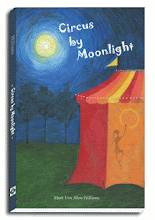
The Prophet of Sorrow by Mark Van Aken Williams
Lucky Press, LLC, has been named a finalist in the The National "Best Books 2010" Book Awards.”--Fiction & Literature, Historical Fiction.
Wednesday, October 13, 2010
Book Review: Speak, Nabokov by Michael Marr
 Speak, Nabokov by Michael Maar
My rating: 3 of 5 stars
In Speak, Nabokov, Michael Maar gives us literary criticism that digs into the fiction of Vladimir Nabokov like a cabalist seeking out the hidden truths. Because we are led to believe that Nabokov is so intelligent, absolutely everything in his fiction is detail and put there on purpose. Nothing is left to chance. And Maar, combining biography with the fiction, also combines different people in Nabokov’s life with the persons that inhabit the fiction. But what of the author is in here? To me, much of it is speculation, much like a detective’s case--a hint here, a clue there. With footnotes galore, we are painted a picture of the philosophical nature of Nabokov’s work being Gnosticism, by aegis of Schopenhauer. I am not a scholar; so much of the jargon was lost foreign to me, both in the text and footnotes. I also have no pretentions of being a metaphorical Holmes. In fact, I tend to get uncomfortable when these guys steer towards literary “outing.” Surly Nabokov must have been homosexual, because of clues left in his fiction. But if this is the way you prefer your analysis, here is a wonderfully slim volume for you. As Maar puts it, “Nabokov is fully present everywhere in his work; even the tiniest sliver contains the whole. And that is why each of these slivers scintillates with a dazzling spectrum of colors—a magic that is hard to convey in analysis.”
View all my reviews
Subscribe to:
Posts (Atom)

 Posts
Posts