Wednesday, October 27, 2010

Book Review: Voltaire's Calligrapher by Pablo De Santis

Voltaire's CalligrapherVoltaire's Calligrapher by Pablo de Santis

My rating: 4 of 5 stars


“Voltaire’s Calligrapher,” is an owlish historical novel, as well as part thriller. It is also a philosophical novel, full of adventure. Dalessius is a twenty year old calligrapher and archivist, who goes to work for the famous Voltaire. Mechanical writing is already on the scene, but the talent of the calligrapher is still needed in a world where invisible and poisonous varieties of ink still have place among enjoyable cat and mouse games, filled with conspiracies, individual manuscripts, libraries, and booksellers. He is raised by an uncle, who makes his living transporting corpses. But once in the services of Voltaire, Dalessius is set out as a spy to look into the case of the suspiciously condemned Jean Calas, but ends up in a web of far greater intrigue between the Dominicans and the Jesuits. At a deeper level, you could say, he finds himself in the middle of the intrinsic struggle between the mephitic remnants of the Dark Ages and its collateral ingredients. The stage is filled with life-like automatons, graveyards, executioners with their ingenious devices, huge homes where it easy to get lost, back alleys, bordellos, henchmen, and poisonous fish. How can you go wrong? The best part—it’s not too long. It is short, amusing, and very, very smart.


View all my reviews

Tuesday, October 26, 2010

New Award


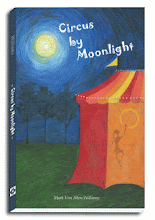
The Prophet of Sorrow by Mark Van Aken Williams
Lucky Press, LLC, has been named a finalist in the The National "Best Books 2010" Book Awards.”--Fiction & Literature, Historical Fiction.

Wednesday, October 13, 2010

Book Review: Speak, Nabokov by Michael Marr

Speak, NabokovSpeak, Nabokov by Michael Maar

My rating: 3 of 5 stars


In Speak, Nabokov, Michael Maar gives us literary criticism that digs into the fiction of Vladimir Nabokov like a cabalist seeking out the hidden truths. Because we are led to believe that Nabokov is so intelligent, absolutely everything in his fiction is detail and put there on purpose. Nothing is left to chance. And Maar, combining biography with the fiction, also combines different people in Nabokov’s life with the persons that inhabit the fiction. But what of the author is in here? To me, much of it is speculation, much like a detective’s case--a hint here, a clue there. With footnotes galore, we are painted a picture of the philosophical nature of Nabokov’s work being Gnosticism, by aegis of Schopenhauer. I am not a scholar; so much of the jargon was lost foreign to me, both in the text and footnotes. I also have no pretentions of being a metaphorical Holmes. In fact, I tend to get uncomfortable when these guys steer towards literary “outing.” Surly Nabokov must have been homosexual, because of clues left in his fiction. But if this is the way you prefer your analysis, here is a wonderfully slim volume for you. As Maar puts it, “Nabokov is fully present everywhere in his work; even the tiniest sliver contains the whole. And that is why each of these slivers scintillates with a dazzling spectrum of colors—a magic that is hard to convey in analysis.”


View all my reviews

Thursday, October 7, 2010

Book Review: The Death of the Adversary by Hans Keilson

This novel is set in Nazi-occupied Europe, although it is never mentioned. There is no guessing here. The adversary is the Führer (referred to as “my enemy”) and the word Nazi is never used. All of this creates an atmosphere where the protagonist fails to come to grips with the reality of the ascendance of National Socialism and the relationship between subject matter and context. Written as memoir, we see how a person who is just as caught up in the culture of his homeland as those who seek to make him an enemy, can only see himself with detachment as a way to protectively shield himself from certain truths, not only about himself but about the horror in the making. This dichotomy is never clearer than when the protagonist (unknown to be a Jew) is sitting with the friends (Nazi thugs) of a girl he has a crush on and them talking about an assignment to desecrate a Jewish cemetery. This is as haunting a scene as you will ever come across in fiction. The prose is astonishing: part philosophy, part psychology, and part poetry—combined to point out the failure of coming to grips with reality. Because of the anonymous nature of the people and places, I was able to transpose this story to a new time, here in America, where the hatred toward Muslims could have the same effect on a young Muslim man who also grew up an American. Certainly a masterpiece!

Tuesday, September 28, 2010

Book Review: Ours--A Russian Family Album, by Sergei Dovlatov

Mark Twain once said, “The quality of humor is the commonest thing in the world. I mean the perceptive quality of humor. In this sense every man in the world is a humorist. The creative quality of humor - the ability to throw a humorous cast over a set of circumstances that before had seemed colorless is, of course, a different thing.” The Russian émigré, Sergei Dovlatov, traces four generations of his family’s life with the circumspect of the truly creative humorist. Through the likes of Uncle Aron, Cousin Boris, Grandpa Isaak, and a terrier named Glasha, we discover the amusing, comical, incongruous, and absurdity that goes hand in glove with the very course of Soviet history. The chaos of the past is remembered and intermingled with a sense of recovery. Even though each life is unique, all lives are familiar to us. So with Cousin Boris, the boy who started with such promise, and was always held up as an example to Sergei (yet somehow kept ending up in prison), we get this—“ I finally understood the ruling trait in my cousin’s character: he was a natural-born existentialist. He could act only in extreme situations: build a career only in prison, fight for life only on the edge of the abyss.” And with Glasha, the terrier—“She was surrounded by esoteric poets, Suprematist painters, composers of atonal music, and sculptors of non-representational constructions. All of them were indefatigable critics of the regime, especially when in their cups. With friends like that, she could hardly have turned out politically loyal. Actually, she herself behaved no better. To be specific, she barked at policemen and generally hated all uniforms, whether on soldiers, sailors, or ticket collectors. Along with this, her displeasure was aroused by red banners and billboards bearing revolutionary slogans, and to top it off, she liked to relieve herself behind a certain building, at the base of a four-meter-tall portrait of Brezhnev.”

The Education Problem in America

When considering the appalling state of education in America, we need to approach the problem and the challenge in an imaginative and innovative way. The old strategy no longer works. So please stop thinking about better unions and throwing huge sums of money at antiquated systems. As odd as this concept may seem to many people, entrenched in their particular paradigms, breakthrough ideas are the answer. Then, and more importantly, we need to take action on these ideas.

First we need to identify what our challenges are (poverty, teacher training, etc.), and then to recognize our goals. This can start with our dissatisfaction—then move to our desires.

I know most of you hate this part, simply because we are used to thinking that “studying something” usually means just putting something off. But it is crucial to access and review all the data we have. You can not innovate without having an objective beginning point.

Once we begin to understand what the problems are, we can then understand the challenges inherent in them. This will help us to focus on what the REAL problems are. We want to come up with the right answers to the right problems.

We must be vigilant about deferring judgment about new ideas. This is where being stuck in old paradigms keeps us from proper exploration. To often these ideas are labeled as wild, outrageous, and out-of-the-box. Making creative connections, taking risks, and trying new associations will lead to potentially innovative scenarios.

Finally, we must generate a barometer needed to analyze and critique these ideas for change, in order to find out which of these are the best ideas.

This country was based and developed on the premise and fruition of great ideas and the action taken to realize them.

Lets do what we’re good at.

Thursday, September 23, 2010

Book Review: Mona And Other Tales, by Reinaldo Arenas

Mona and Other TalesMona and Other Tales by Reinaldo Arenas

My rating: 2 of 5 stars


This is a work of stories and other pieces of short fiction, much of which appeared to be experimental, or so it seemed to me because it resembled a bad nightmare. I’m not fond of reading ten or twenty pages and when I’m done I just shake my head and say, “What the F***?” In all fairness though, I did find one story, “Mona,” to be very engaging and thoroughly kept my disposition to incredulity aux abois. I know that Arenas is supposed to be one of the Latin American greats (and they made a movie about his life), but I guess I’ll leave the experts to their precincts, and go search out my copy Ring Lardner short stories.


View all my reviews